AUTOMOTIVE SUPPLIER USE CASE #3
Representative profile.
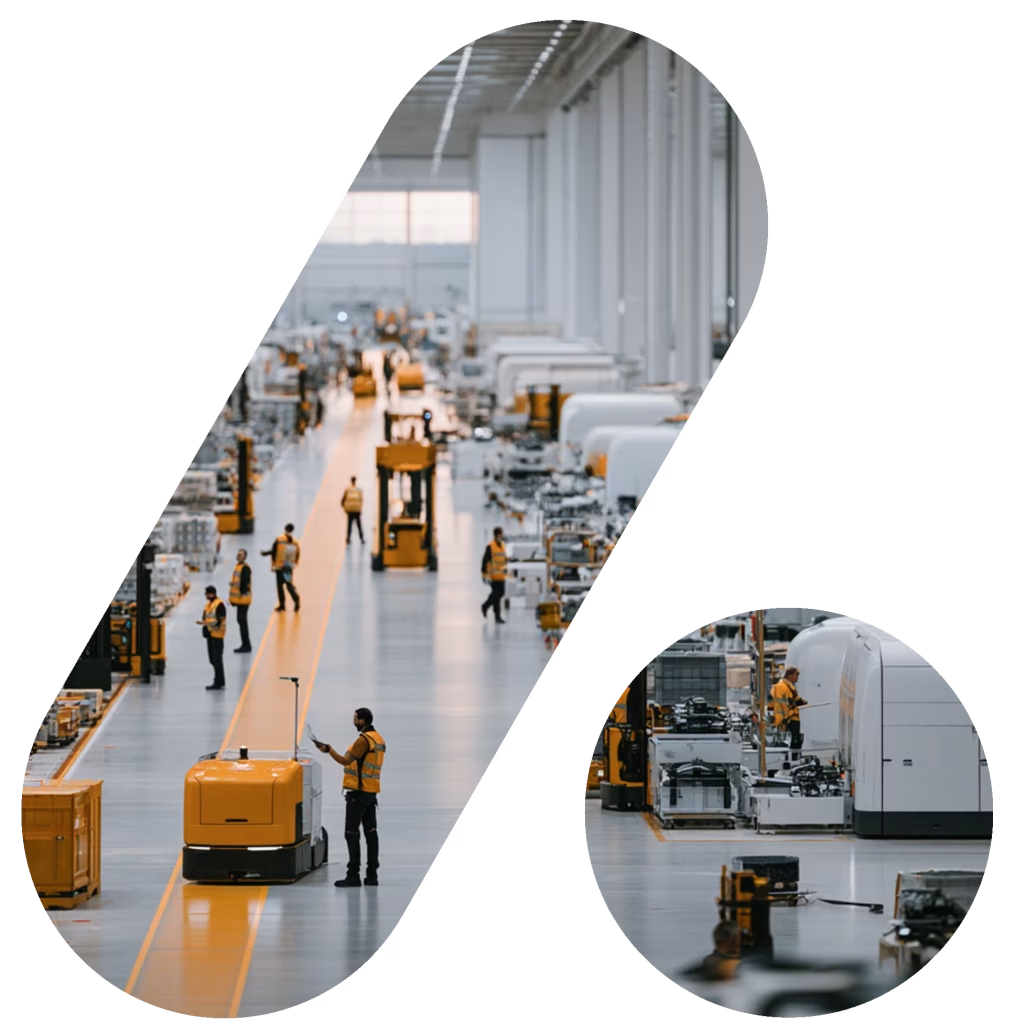
A Tier 1 automotive supplier operates just-in-time production for multiple OEM customers. Its plants run heterogeneous automation environments across PLCs, HMIs, robots, drives, and other critical systems. Production continuity is not only an internal KPI: a prolonged outage can quickly affect customer schedules and downstream assembly operations.
What breaks today.
When a cyber incident, hardware failure, or unwanted configuration change disrupts production, the technical problem is only the beginning. Teams first have to establish what happened. Which systems were affected? Did configurations change? Which version was running before the incident? Is there a trusted backup? Can the affected equipment be returned to the required operational state — and how long will that take?
In a just-in-time supply chain, those questions quickly become customer questions. The industry has already seen how disruption at a supplier can propagate into OEM production. In 2022, a cyberattack on Kojima Industries forced Toyota to temporarily halt production at all 14 of its Japanese plants, affecting approximately 13,000 vehicles of daily output.
What changes with Octoplant.
Octoplant gives recovery teams a trusted operational starting point. Automated backups, historical versions, and configuration records help teams understand what was running before the incident and whether the operational state changed. Instead of reconstructing configurations from engineering laptops, local folders, or individual knowledge, authorized teams can work from centrally maintained historical data and identify the appropriate recovery state. Version history and configuration comparison also provide context for the investigation: what changed, when it changed, and how the current state differs from previous versions.
The objective is not to replace cybersecurity detection or incident-response tools. It is to make sure that once an incident has been contained, production teams have the configuration history and recovery data needed to bring affected automation back under control.
Recovery readiness becomes part of the supplier’s customer promise.
What it’s worth.
A supplier’s downtime does not stay inside the supplier’s four walls. In a just-in-time production network, extended disruption can affect customer schedules, contractual relationships, future sourcing decisions, and ultimately the OEM’s production line.
The business case is therefore larger than the supplier’s own lost production. Faster access to trusted historical states reduces uncertainty during recovery, shortens the path from investigation to restoration, and gives the customer evidence that continuity is engineered rather than assumed.
Reduce recovery time. Reduce uncertainty. Protect the customer relationship.